Custom Instructions (Prompts)
Custom instructions are extra guidance you give Wallu about how to behave - tone, rules, and context about your server. They don't add knowledge (that's what knowledge sources are for); they shape how Wallu answers.
A short bullet list usually works best:
- You are a support bot called Wallu for the server {server_name}
- Be friendly and concise
- If you can't solve the issue, suggest opening a ticket in #support
- Today is {current_date} ({week_day})
Where to set them
| Scope | Where | Use it for |
|---|---|---|
| Global | Settings | Server-wide tone and rules that apply everywhere |
| Per channel / category | Channels | Different behavior per channel or ticket category |
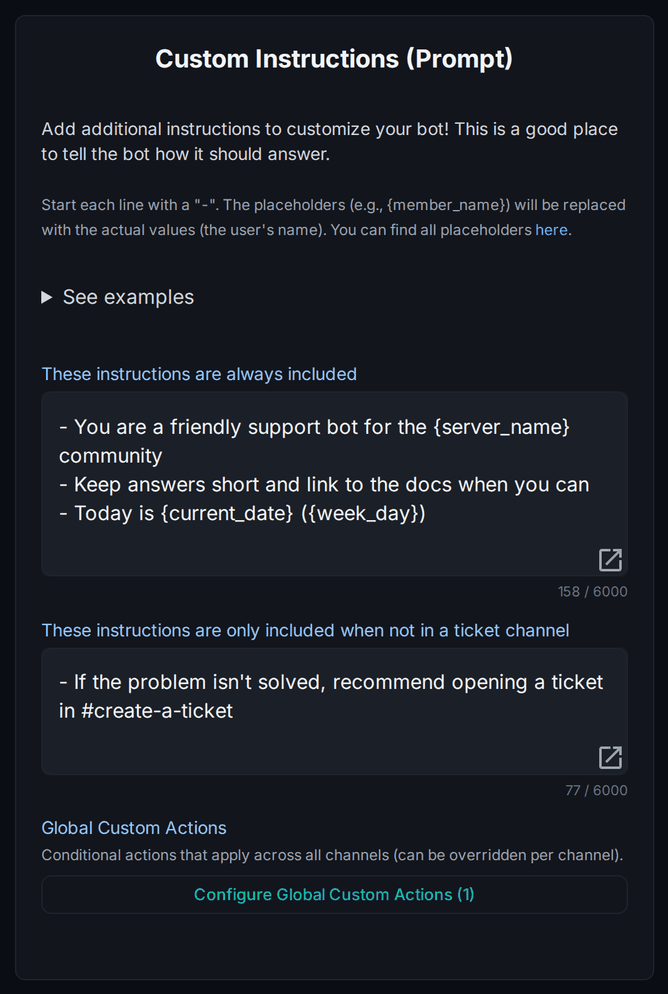
Channel and category instructions are added on top of your global ones, so keep the global set general and use per-channel instructions for the specifics (e.g. a billing ticket category vs. a general help channel).
On the Settings page there's a separate "non-ticket" instruction box. It's the right place for things like "recommend opening a ticket if the issue isn't solved" - advice that makes sense in regular channels but not inside a ticket the user already opened.
Role mentions (pings)
Wallu only pings a role if you reference it in your instructions or custom actions - e.g. "mention @Moderators if the user reports a scam". A role referenced only in a channel's or category's instructions can only be pinged in those channels; global instructions and custom actions allow it everywhere. Your knowledge (documents, imported channels) never allows pings. Role mentions that users try to get Wallu to send (and roles not referenced anywhere in your instructions) are sent as plain text without notifying anyone. @everyone/@here are never pinged outside the ticket escalation message.
Placeholders
Placeholders are filled in automatically when Wallu answers, e.g. {server_name}, {member_name}, {current_date} (YYYY-MM-DD) and {week_day}. They're great for greetings and date awareness.
See the full placeholder reference →
Rules that fire in specific situations
Instructions shape every answer. When you want something to happen only in a specific case - "if the user reports a scam, escalate and ping @Moderators" - use a custom action instead. They're IF/THEN rules and they take priority over your instructions.
Length limits
Instructions are sent to the AI with every answer, so a long set costs credits on every single question. They're capped:
| Field | Limit |
|---|---|
| Global instructions, non-ticket instructions | 6000 characters |
| Per-channel / per-category instructions | 6000 characters |
| A custom action's condition or action | 1000 characters |
| Number of custom actions | 15 per list |
| Auto-rename ticket instructions | 500 characters |
The custom action limit is per list, so your global actions and each channel's actions each get their own 15.
If you're bumping into a limit, that's usually a sign the text contains knowledge rather than behavior - move it into a FAQ or document, which Wallu only loads when it's actually relevant to the question.
Servers whose instructions were already over a length limit before it existed keep working: you can leave that text as-is or shorten it, you just can't make it longer.
Best practices
- Be specific and brief - a few clear bullets beat a wall of text.
- Don't restate knowledge - put facts in FAQs/documents; keep instructions about behavior.
- Avoid contradictions with your knowledge sources, and remove outdated references (old events, old policies).
- Test it - ask a question after changing instructions to see the effect.
Need a hand crafting instructions? Ask in Wallu's Discord or email [email protected].